YouTube Channel

Showing posts with label Writing. Show all posts

Thursday, July 17, 2014

Thesis Structure

Different area has different version of thesis structure. For Information System/Computer Science - we usually has:
  1. Introduction
  2. Literature Review
  3. Research Methodology
  4. Technique Development/Data Collection
  5. System Development
  6. System Evaluation
  7. Discussion
  8. Conclusion
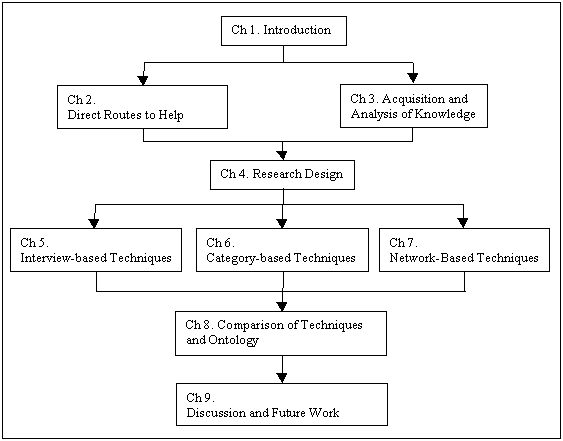
It can be change depends on your research methodology and your supervisor or university style. Below is a figure that I find useful in structuring the thesis:


Chapter 2 can be divided into two (Chapter 2 and 3) if your literature is very wide and involve a lot of analysis. Basically Chapter after that is the same. It will be based on your research methodology. So hope this help. :)

Thursday, May 15, 2014

Ginger - Correct Your Grammar

LS has tried a few software to help in correcting grammar. One of the best so far is Ginger.


Ginger can be used in Windows, Word and Android. It can help you in correcting your grammar and rephrase the sentences. You can try it using the free version. Download it here!!


Tuesday, February 11, 2014

RO vs RQ

Penyelidik haruslah tahu apa itu RO dan RQ. RO ialah Research Objective manakala RQ ialah Research Question. Penyelidikan selalu bermula dari RQ. Daripada literature review kita akan jumpa GAP dan dari GAP kita keluaran RQ. Kemudian dari RQ kita hasilkan RO.


Tapi sebagai penyelidik amatur kadang-kadang bukan mudah nak keluarkan RQ. Jadi apa yang kita buat ialah kita mulakan dengan RO dan hasilan RQ. So macam mana nak hasilkan RQ. Ok mula-mula kita senaraikan RO kita seperti di bawah ini:
 
1. To investigate the need for an IST with LS consideration
2. To determine a method to categorize RMs based on LS
3. To develop and evaluate the LS based IST prototype
 
Kemudian, daripada RO, kita hasilkan soalan. Soalan boleh satu atau lebih. Soalan yang dihasilkan haruslah boleh menjawab atau menghasilkan jawapan kepada RO kita seperti contoh di bawah:
  
Objective 1: To investigate the need for an IST with LS consideration.
RQ 1: Are students having difficulties to find suitable RM for their learning needs?
RQ 2: Is there any relation between RM and LS?
RQ 3: Are there available ISTs that support students’ LS?
 
Objective 2: To determine a method to categorize RMs based on LS.
RQ 4: How can primitive elements in RM be categorized based on LS?
 
Objective 3: To develop and evaluate the LS based IST prototype.
RQ 5: Can the prototype perform better?
 
Pada permulaan penyelidikan kita senaraikan dulu RO dan RQ, nanti bila dah siap semua kita boleh revisit dan betulkan balik. Satu lagi, pastikan RO dan RQ logik dan boleh diukur. Maksudnya - kalau kita buat RO kit a- To improve student understanding - kita mesti pastikan adakah kita mempunyai cara yang reliable untuk ukur kadar kefahaman pelajar tu. Bukan sekadar yes or no. Nak improve understanding agak abstract maka perlu berhati-hati. So kena ingat ya!!
Friday, January 10, 2014

Tips: Chapter Conclusion

Chapter Conclusion sangat penting kerana chapter inilah yang akan menentukan kecapaian objektif penyelidikan anda. Di bawah ialah susunan untuk Chapter Conclusion (andaikan Chapter itu ialah Chapter 8).


8.1 Research Findings
Perbincangan semula setiap Research Question dan juga Research Objective. Bincangkan findings yang berkaitan bagi menjawab setiap persoalan dan menunjukkan kajian yang kita jalankan mencapai objektif yang ditetapkan.
 
8.2 Key Findings/Contributions
Senaraikan penemuan dan sumbangan kita sama ada dari segi teori, kerangka kerja, teknik atau system.
 
8.3 Limitation
Senaraikan kekangan yang kita hadapi - bukan kelemahan tapi kekangan. Contohnya: Most of the survey items in the preliminary study and the evaluation used a categorical scale. This limited the capability of the data analysis.
 
8.4 Future Work
Berdasarkan kekangan kita, cadangkan apa penambahaikan yang dapat meningkatkan lagi mutu research.
 
8.5 Conclusion
Rumuskan balik: Objektif, Findings dan Conclude hasil research kita - mencapai objektif ke tidak.
 
Ok. Boleh start check format :)

Sunday, October 20, 2013

Check Your Grammar - Paper Rater

One of available online tool that we can use to check our grammar - Paper Rater.
 
 
This is the Paper Rater page. Copy paste your paragraph to the box below.
 
 
You also need to fill in other field such as Title, Works Cited (just put Nil if you don't have one) and choose answer for multiple choice for others question. For academic purpose, you can choose Research Paper. Then click button Get Report.


Then, you will be forwarded to this page.
 
 
You can choose to see various type of reports by clicking the menu in your right as Figure below.
 
 
You check you plagiarism percentage, spelling, grammar and other reports. Below is the plagiarism report. See - no plagiarism :) Clap2 to myself :)


Below is the grammar report - this one has no grammar error.

 
But if you have one, this is how the notification will show.


That's all for now. This is just one of tool that we can use to check our grammar. Will discuss other tool in the coming post. :)


Tuesday, October 8, 2013

Short Academic Biography

Bila menulis paper jurnal atau conference - kita dikehendaki untuk menulis short biography. Untuk menulis short biography ni, perkara yang perlu ada ialah:

  • name
  • position
  • department, institution
  • degrees held
  • research interests

Example 1:Untuk student

Nor Liyana Mohd Shuib received the Bachelor degree in computer Science from Universiti Teknologi Malaysia and Master Degree in information technology from Universiti Kebangsaan Malaysia, in 2005 and 2007, respectively. She is now a PhD candidate at Universiti Malaya, Malaysia. Her research interests include data mining, education technology and information retrieval tools.
 
Example 2: Untuk academic staff
 
Nor Liyana Mohd Shuib is currently a Fellow at Department of Information System in the Faculty of Computer Science & Information Technology, University of Malaya. She graduated with BCS (Information System) in 2005 from Universiti Teknologi Malaysia and MIT (Information Technology) from Universiti Kebangsaan Malaysia, in 2007. She obtained her PhD in 2013 from Universiti of Malaya, Malaysia. Her research interests include data mining, education technology and information retrieval tools.
 
Template:
[[Name]] is a [[Position]] in the [[Department]] (with a specialization/concentration in [[Specialization]]) at [[Institution]]. S/he obtained her/his [[Degree]] from [[Instituition]] in [[Year]]. S/he is interested in [[research/teaching interests]].
 
Source:
 

Monday, September 2, 2013

Atlas.Ti Workshop

Last week I attended Atlast.Ti workshop at UIAM. The workshop is conducted by Kak Zie. Alhamdullilah, I learn a new technique that can be apply in conducting literature review. In this workshop, I learn about using Auto-coding function in Atlas.Ti. Insyaallah will share it here. For more information of their workshop, click HERE:


Tuesday, July 10, 2012

Paraphrase Your Paragraph As Easy As 1,2,3

Sometimes we are having a hard time to paraphrase the paragraph. We need to paraphrase our paragraph especially if we want to publish part of our thesis as a journal. This is one of the software that LS used: CLICK HERE.

Just copy paste the paragraph in the box. Click figure to see the larger view.

You can choose one of the recommendation from the tools


Click the orange button and the new paragraph will appear in the box. You can try to rephrase it for a few times to get a better paragraph.
 
 
Hope this help :)

Tuesday, August 3, 2010

Phrases to use in academic writing

I have been very busy these past few weeks, as I have had to settle my SLAB contract, writing conference papers and writing literature review to complete developing my framework. There are a lot to share but too little time to do it.

Today I would like to share one great website that provides a list of phrases that can be used in academic writing. It is really helpful especially when you want to write the literature review or reporting your results.